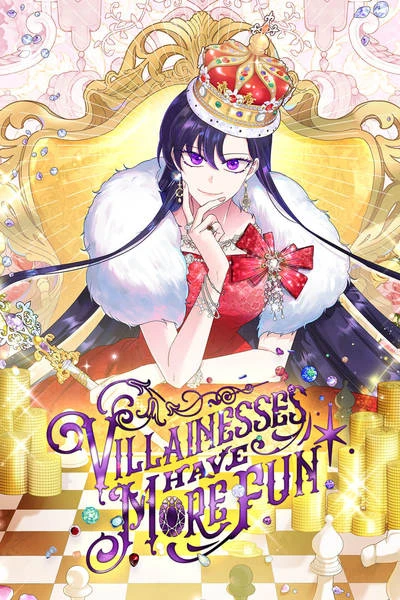
A Tale of Two Villainesses: Comedy vs. Angst
There is something fascinating about this series; throughout my reading, I couldn't help but compare it to Kill the Villainess. I think there are several similarities that demand attention. It isn't just that both main characters have long dark hair and striking eyes, but rather how they represent two distinct ways to handle the "villainess" trope. These two stories mirror each other, yet their difference in tone creates vastly different results: Kill the Villainess is a gritty, angsty drama, while Villainesses Have More Fun functions largely as an absurd comedy.
Villainesses have More Fun's Characters
Reilynn Candmion
The reincarnated protagonist (a 30-something woman in a 19-year-old body). Originally a "simpleton" villainess known only for her beauty and extravagant spending, she evolves into a sharp, self-aware successor who uses her family's immense wealth as her primary weapon.
Iris Van Conrad
The "original" heroine of the story and Reilynn’s rival. She plays the archetype of the "white lotus"—acting sweet and naive to manipulate the men around her. However, she lacks true strategic depth, often relying on the plot's "charm" rather than actual brilliance.
Prince Friedrich
The Crown Prince and a "disaster" of a male lead. He is defined by deep-seated parental trauma and a volatile temperament. He spent years bullying the original Reilynn to soothe his own insecurities, making him a deeply polarizing figure.
Lucas Van Heirreth
The Master of the Information and Assassin’s Guild. Behind his charming exterior lies a man with his pulse on every secret in the kingdom. As a suitor, he is Reilynn’s most dangerous and efficient ally, providing her with the "intel" she needs to navigate political plots.
Sir Cassion
A commoner turned knight.
Lord Barrod
The heir of House Carlos and one of the more grounded suitors. As the successor to his mother, he represents a stable and high-ranking noble lineage.
Duke Candmion
Reilynn’s father and the head of the powerful Candmion house. Though he deeply loves his daughter, he is surprisingly pragmatic.
Javier
Originally a slave purchased by Reilynn. Despite being a century-old being trapped in a child’s body due to trauma, his status as her "property" and his stunted emotional development make his inclusion in the romantic harem deeply problematic
Worldbuilding and the Morose Kingdom
In terms of worldbuilding, there isn't much that feels truly innovative, aside from the fact that the kingdom is heavily dependent on other noble houses to thrive. As I write this, I realize that while other works might feature this dynamic, they rarely give it as much importance as this story does. I found it quite interesting to see a royal family that is actually "morose" and weakened compared to the other houses; it honestly makes you wonder why the kingdom even exists at all.
The Lore and the Problem with Social Commentary
Regarding the lore, most of it works because it follows established genre beats—a historical setting populated by shapeshifters and mages. However, certain elements of the lore didn't quite land for me. I understood what the author was trying to achieve, but I don't think it accomplished its goal.
I’m not sure if this was a translation issue, but my understanding was that commoner women rose up to gain rights in this world, whereas noble women were denied that luxury because society expected them to remain quiet and complacent. If that was the intention, I understand the sentiment, but comparing the struggles of lowborn women to royal women didn't hit the mark for me. This is especially true when it's revealed that a member of the royalty essentially kidnaps and abuses both lowborn women and underage girls. I simply don't see how choosing not to speak up to maintain a wealthy status quo is comparable to being kidnapped and enslaved.
Reilynn’s Growth: From Simpleton to Successor
To quote the "Kim, there’s people that are dying" meme: slavery exists in this world, so what are we doing to abolish it? This was one of my main issues with the female lead early on; she felt too simple-minded given the stakes.
However, I seriously appreciated that as the story progressed, Reilynn had to prove herself to become the family successor. I originally assumed everything would be handed to her because her father loves her so much. To my surprise, he was actually aware of her past bad deeds and incompetence. There was this scene where several ladies discussed their skills—poetry, mathematics, etc.—and Reilynn’s only talent was "spending money happily." It gave everyone (including me) secondhand embarrassment, but it was refreshing to see how self-aware that moment was. It was the introspective "kick" Reilynn needed to start acting and earning the Cadamon legacy.
The Disparity of the Villainess: Iris vs. Reilynn
This might be an unpopular opinion, but I didn't like the interactions between Iris and our lead. You might say, "Well, duh, they’re enemies," but the issue was the power disparity. Iris's "wrongdoings" couldn't compare to Reilynn’s power. Iris didn't feel like a true villainess; she felt like a character intended to be evil who ended up looking silly and pitiful.
The author tried to frame Iris as a strategic mastermind, but she fell short of that title. She supposedly manipulated the male leads to humiliate Reilynn, but honestly, the men in this story aren't very sharp. They seemed charmed by Iris’s "fake naivety" simply because the plot required it to be so. I can't buy the idea that she outsmarted four well-educated men; she certainly isn't on the level of someone like Rashta from The Remarried Empress.
Consequently, because Iris read like such a "wannabe," Reilynn’s retaliation—showing how easily she could ruin her or even physically harm her without anyone intervening—felt like complete overkill. I wish we had been given a villainess who could actually match our heroine's energy and cunning.
The Problematic Harem: From Trauma to the "Ick"
The Crown Prince, Friedrich, is a disaster. He isn't fit to be king; the guy can't even rule himself. One second he’s pitiful, and the next he’s a lunatic. The revelation that the "real" Reilynn allowed him to bully her just so he could feel better about his parental issues was stomach-turning.
As for the other male leads, I only really like Barrod and Lucas. They are charming and feel like excellent fits. Sir Cassion is "just okay." He’s pretty, but that’s about it. He reminds me of Anakin from Kill the Villainess, but while Anakin was the "sane" anchor of that story, Cassion is just the most boring person in this one. Even the magician is more interesting because, well, he has magic.
Then there is Javier. While I appreciate that Reilynn only feels motherly affection for him, I felt a massive "ick" when he was included as a potential romantic interest. Not only does he look like a child, but he behaves like one. Considering our protagonist is a woman in her 30s reincarnated into a 19-year-old body, it feels very out of place. I know his backstory explains that he’s been trapped in a child’s body for a century due to trauma, but he is still mentally underdeveloped. No amount of "shirtless scenes" will change that. He shouldn't be romanticized or sexualized. I’m rooting for the manhwa to deviate from the novel's ending if the rumors about them ending up together are true.
Final Thoughts
Ultimately, Villainesses Have More Fun is a comedic take on the genre that still manages to be serious when the plot demands it. If you are just starting to explore "Villainess" stories, this is a solid choice—just don't take the plot too seriously, and don't expect a heavy focus on romance. The political subplots are far more prominent than the love interests, at least in the first half.
I honestly have a hard time with stories that attempt to be lighthearted while maintaining dark underlying themes. It leaves me wondering: Are we supposed to be having a good time, or are we supposed to stop and think before we enjoy ourselves? I believe it overcomplicates things when a story’s tone leans toward the sillier side while the stakes are unnecessarily grim.